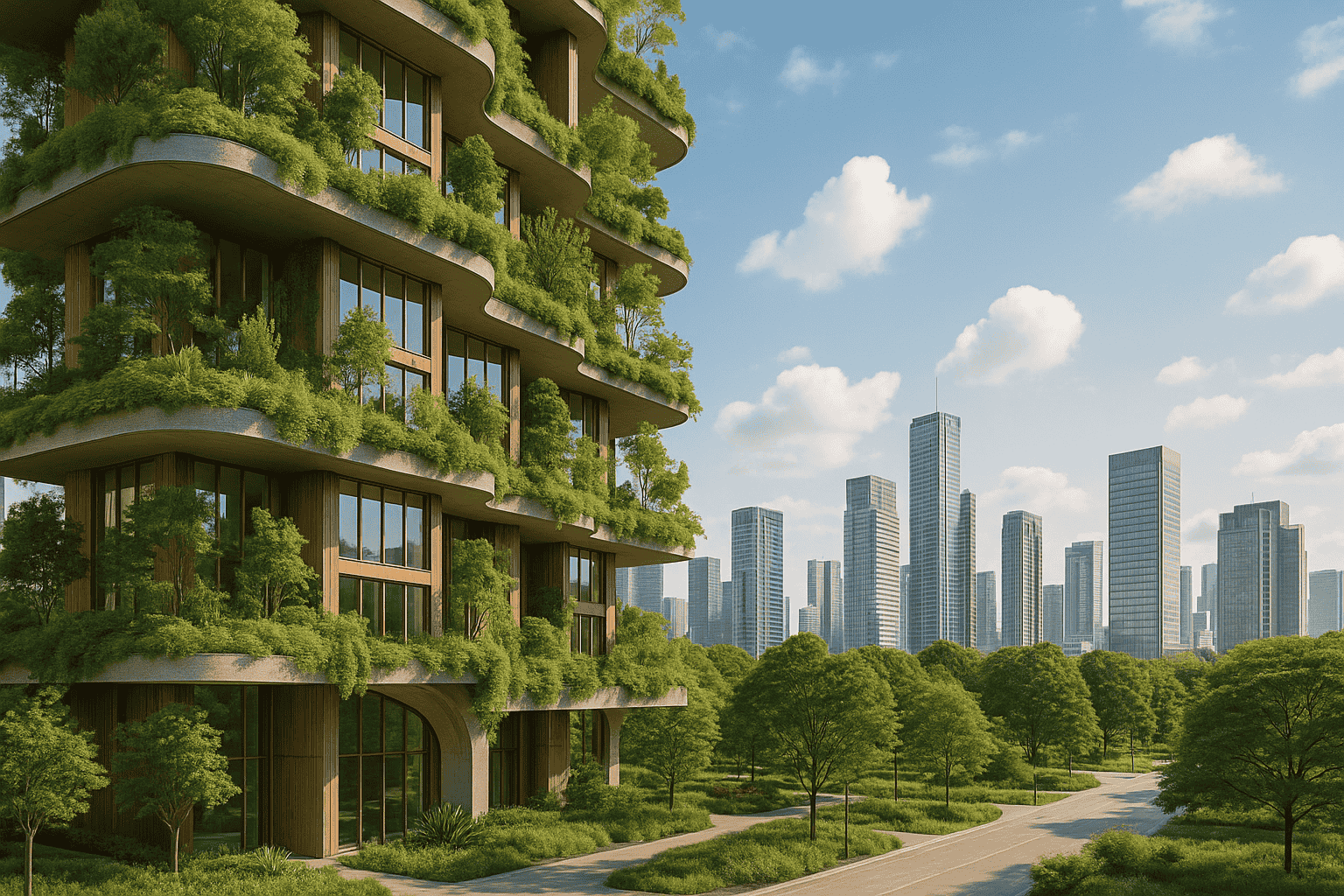
Accelerating urbanization on a global scale, intense work rhythms and increasingly artificial spaces are weakening humanity’s connection with nature. Life in modern cities often turns into a routine surrounded by concrete surfaces, enclosed volumes and artificial lighting. Yet human beings are, by nature, predisposed to live in harmony with the natural environment, as they have for thousands of years. That’s precisely why biophilic architecture is not merely an aesthetic trend; it is becoming a core component of human health, productivity and sustainability.
The intellectual foundations of biophilic design trace back to the 1980s and Harvard biologist Edward O. Wilson’s Biophilia hypothesis. Wilson demonstrated scientifically that humans have an instinctive affinity for nature and that severing this bond leads to physical and psychological problems. Today, from Singapore to London, from Copenhagen to Tokyo, many cities are adopting biophilic planning at the urban scale and developing integrated solutions that extend from public spaces to housing, from bridges to high-rises.
The common thread of biophilic architecture:
Integrate the building into nature, not nature into the building.
Modern architecture now stands at the very center of this transformation.
Aura Design’s Approach: A Universal Language with Local Sensitivity
At Aura Design, we don’t merely follow the international biophilic design movement; we bring our region’s sun, climate, landscape and cultural fabric into our work to produce an original interpretation.
We approach biophilic design as a whole in which
- natural light defines the primary spatial layout,
- the boundaries between inside and outside become permeable,
- the landscape becomes an inseparable extension of the architecture, and
- organic, fluid forms set the rhythm of space.
Architecture that is integrated with nature creates spaces that not only look beautiful but also live, breathe, heal and form an emotional bond with their users. Today, many urban-induced problems such as stress, burnout and loss of productivity can be significantly reduced through nature-aligned spatial design. For this reason, we see biophilic architecture not as a contemporary fad but as an indispensable criterion of human-centered design. Biophilic architecture is no longer just a movement; it is a fundamental approach shaping the future of cities.
When this global movement converges with Aura Design’s vision, it opens the door to spaces that are sustainable, calming, inspiring and in harmony with the natural rhythm of human life.