

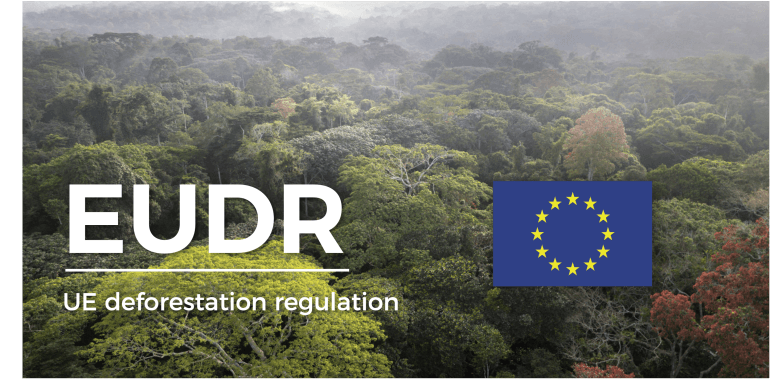
The European Commission has announced a targeted package of measures to support companies, Member States and third countries in the smooth and timely roll-out of the EUDR. While aiming to ensure the full operability of the EUDR’s IT system, the package also seeks to simplify reporting obligations—especially for micro and small operators—without weakening the traceability mechanism.
Who Benefits from the Simplifications
The Commission proposes to remove the due diligence statement obligation for downstream operators in the supply chain—such as retailers and large EU manufacturers—under the EUDR. This means that only a single statement would be filed in the EUDR IT system at the market’s entry point by the operator who first places the product on the EU market.
For example, for cocoa beans, the importer would submit a single statement, while chocolate manufacturers would not need to file a new one in the system. For micro and small primary operators selling directly from low-risk countries, a simplified one-off statement is foreseen. If the required information already exists in a Member State database, these operators will not need to take additional action in the IT system. This arrangement replaces the requirement to submit regular statements.
Transition Period and Implementation Timeline
A phased transition is planned for the EUDR’s application. For medium and large companies, the date of 30 December 2025 is maintained, with a six-month alignment period for checks and penalties.
For micro and small enterprises, the application date is set for 30 December 2026. The Commission notes that the IT system was launched in December 2024 and has been operated together with stakeholders; new transaction-volume projections indicate a much higher load than expected. The revised dates and simplified obligations are designed to ensure the system can handle this load. The Commission is also preparing contingency plans to enable economic operators to meet their obligations if co-legislators do not adopt the proposal in time.
Background and Previous Steps
The EUDR aims to ensure that certain commodities and products placed on the EU market or exported from the EU do not cause deforestation or forest degradation. Since the Regulation entered into force in June 2023, the Commission has supported implementation through simplification work, guidance, FAQs and a benchmarking implementing act. The simplification efforts are expected to reduce companies’ administrative costs and burdens by around 30%. In addition, an extra 12-month phased transition was defined in December 2024.
Next Steps in the Process
The proposal will now be negotiated by the European Parliament and the Council and will enter into force once formally adopted. The Commission calls for swift adoption of these changes related to the application period extended to the end of 2025.
Highlights from Official Statements
Commission Vice-President Teresa Ribera underlined that the approach streamlines traceability for micro and small producers while preserving oversight, and allows for a gradual alignment for large operators. Commissioner for Environment, Water Resilience and Circular Economy Jessika Roswall stressed that the package addresses real-world implementation challenges, with the aim not to dilute the objective but to enforce the rules more effectively and intelligently.