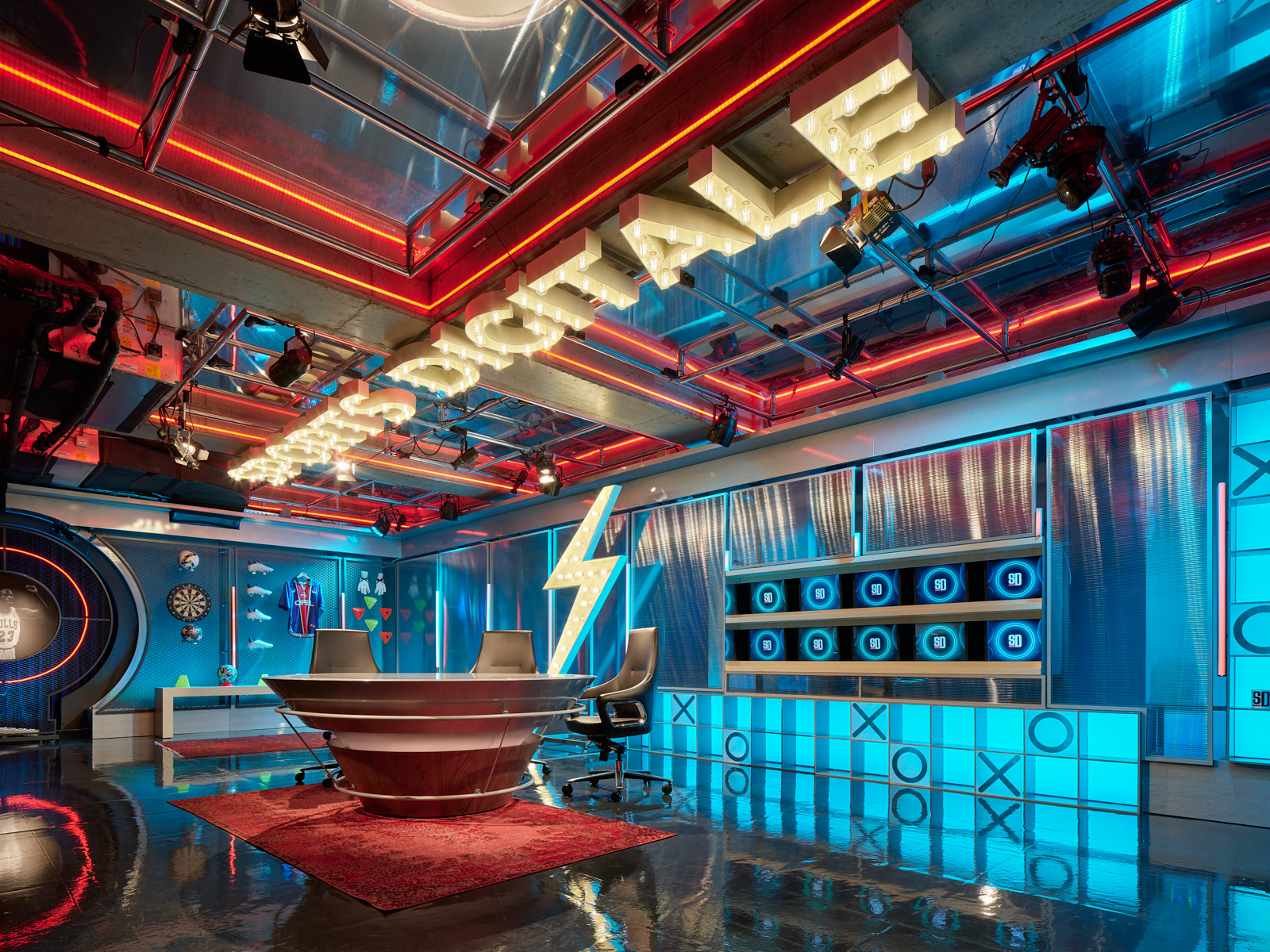
Led by İrem Arıbaş, Hüseyin Beş, and Yurdaer Beş, BAB Architects approaches broadcast studio design not as a space used solely for filming, but as a holistic production environment. While fully resolving technical parameters such as acoustic and lighting arrangements, equipment placement, camera movement zones, operators’ control needs, and circulation, the team also emphasizes that studios are representative spaces that make an institution’s message, broadcast language, and brand identity visible.
Architect İrem Arıbaş expresses this approach as follows: “The color palette, material selection, graphic language, and set design that define a space’s story determine not only ‘how it looks,’ but also ‘what it tells.’ For this reason, at BAB Architects we adopt a holistic approach that blends technical requirements with corporate image in the same crucible and enables fast installation and modular scenarios. While designing the studio’s technical infrastructure together with acoustic paneling, lighting grids, digital screens, camera lines, and control rooms, we simultaneously develop the scenario for the studio’s visual language. With design tools such as the color palette, surface character, the balance of artificial and natural light, and logo and graphic integration, we strengthen the relationship between the brand and its audience, while creating a flexible and transformable foundation for different broadcast types through modular set components. In this way, we achieve technically optimal performance in studio designs and make the institution’s story visible within an aesthetic unity.”
Emphasizing that each broadcast format brings its own rhythm and mode of representation, BAB Architects establishes a clear, reliable, and corporate language in news studios, highlighting the scale of graphic screens, data flow, and the dominance of cameras over the space. In talk-show formats, warmth, flexibility, and building a connection with the audience take priority, and seating layout, camera angles, and decorative elements are handled through a relational approach. In sports broadcasting, dynamism, fast-paced graphic usage, and moving lighting scenarios define the spatial atmosphere. While shaping these differences, audience psychology is also integrated into the design process, stillness that supports a sense of trust becomes important for news broadcasts, while color and lighting decisions that amplify energy come into play in entertainment and sports programming. Thus, depending on the broadcast type, the space produces both a technical and an emotional response.
Although broadcast studios are designed for the camera, according to Interior Architect Hüseyin Beş, the presenter, guest, operator, and viewer are always placed at the center, and design decisions are made along the main axis of these elements: “Comfortable ergonomics, eye-level lighting, and spatial integrity support the natural flow of broadcasting, while controlled circulation, rapid intervention capability, and easy access to technical components ensure that the production process remains efficient and sustainable. In the viewer experience, color, light, spatial depth, framing background, and the use of graphics directly shape perception and emotional impact.”
Interior Architect & Set Designer Yurdaer Beş explains the impact of broadcast studio design on viewers as follows: “Even if the viewer is not physically present in the space, the studio’s character passes through the screen and defines perception. That is why we build the layout, color palette, lighting plan, and visual effects around content and viewer psychology. The background seen by the camera, how surfaces reflect light, the language of graphics, and the density of digital screens evoke different emotions in the viewer. Blue and neutral tones reinforce a sense of trust in news broadcasts, warm palettes create intimacy in talk-show formats, and in sports broadcasting, fast lighting transitions and graphic animations increase the tempo. Broadcast studio design functions as an invisible guide for the viewer.”
Interior Architect Hüseyin Beş notes that among the key trends recently influencing broadcast studio design are the scaling up of LED screen technologies, XR/AR supported set designs, real-time graphics integrations, smart lighting systems, and data-driven broadcast infrastructures, and he evaluates this process as follows: “XR technologies create scenes that go beyond the physical set in live broadcasts, while high-resolution LED panels expand the representational field. When we integrate these technologies into the space, we pay particular attention to ensuring that the set design is not dominated by technology and that systems remain updatable in the long term. This approach enables us to build a sustainable relationship with technology.”
According to the founders of BAB Architects, trends are treated not merely as a visual layer, but as design inputs that directly affect the studio’s operation and spatial character. In this context, studio design is evaluated across three main planes: technological, aesthetic, and behavioral. While LED, AR, XR, and smart lighting systems generate new functions, materials’ reflective qualities, matte–gloss balances, graphic surfaces, and color codes define the spatial language. Meanwhile, camera angles, broadcast rhythm, and shifts in viewer expectations shape the behavioral layer. By deliberately avoiding short-lived fashion effects, timeless studio spaces are designed through modular components and updatable digital surfaces.
BAB Architects approaches broadcast studio design as a strategic field where technology, aesthetics, and human experience intersect. By creating studio environments that offer a flexible, sustainable, and powerful narrative language in response to changing broadcast formats, advancing technologies, and evolving audience expectations, the practice answers tomorrow’s broadcast spaces today by integrating functionality with aesthetics and blending technical infrastructure with brand identity in every project.