

Forests are often far more than just trees. Forest ecosystems are the essential infrastructure of life, from stabilizing the climate and safeguarding the water cycle to sustaining soil fertility and biodiversity. For this reason, forests are not only an environmental topic, they sit at the intersection of the economy, social justice, disaster risk management, and foreign trade agendas.
The global picture clearly shows that good intentions alone are not enough in forest management. According to FAO data, annual deforestation in the 2015–2020 period was estimated at 10 million hectares. FAO’s 2025 assessment puts the world’s total forest area at around 4.14 billion hectares, roughly 32% of the Earth’s land area, and emphasizes that although the net loss rate has slowed, pressure on forests continues.
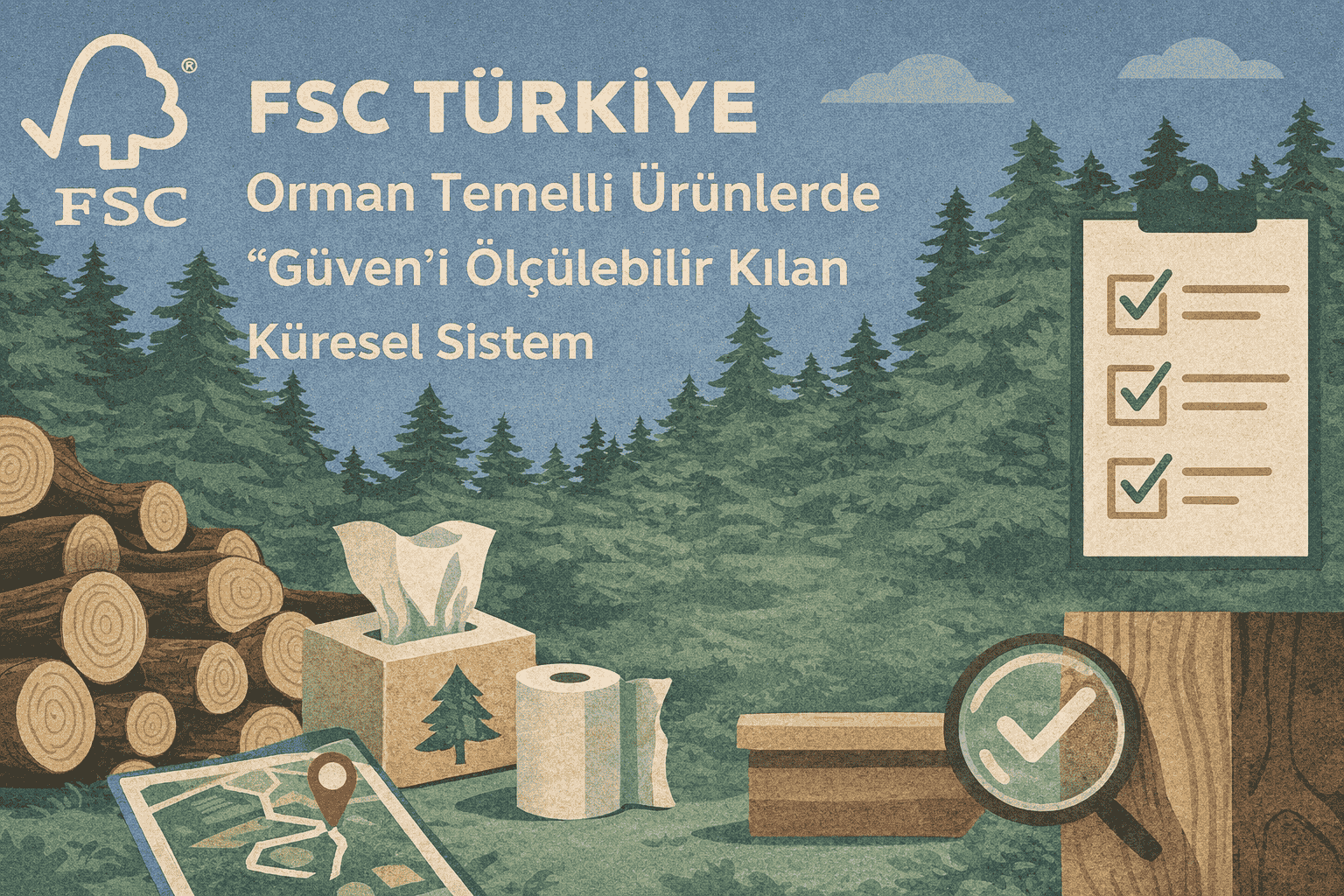
In this environment, the most critical question is this: How can we know whether a “sustainability” claim in forest use is actually true? Supply chains are becoming increasingly layered and cross-border. In this debate, the role of international standards is to turn abstract “good intention” narratives into a measurable and auditable framework. One of the world’s most widely used forest certification systems, the Forest Stewardship Council (FSC), defines responsible forestry as managing forests, based on shared rules and standards, in a way that is (1) environmentally appropriate, (2) socially beneficial, and (3) economically viable. The role of certification is to provide a “measurable” and “auditable” framework that brings these three pillars together.
Within this framework, the Forest Stewardship Council (FSC) stands out as one of the most reliable references globally. Forest Stewardship Council (FSC) emphasizes that its standards are among the strictest certification frameworks in the world, applied in a globally consistent manner while being adapted to national contexts, and built on a governance model where economic, social, and environmental perspectives are represented in a balanced way.
Trust in Forest Stewardship Council (FSC) is supported not only by statements of principle, but also by consumer and market data. In a study conducted with Ipsos, covering 26,800 consumers in 33 countries, 46% of global consumers stated that they recognize the Forest Stewardship Council (FSC) logo. The same study shows that 80% of consumers who recognize the Forest Stewardship Council (FSC) trust brands carrying the Forest Stewardship Council (FSC) label. In addition, it is reported that Forest Stewardship Council (FSC) has more than 65,000 Chain of Custody certificate holders, a figure stated to be higher than other forest certification systems.
The system’s impact is also measurable from a business perspective. 74% of certificate holders say Forest Stewardship Council (FSC) contributes to corporate social responsibility communications, and 83% state that it strengthens corporate image. Forest Stewardship Council (FSC)’s approach to validating claims and reducing greenwashing risk is supported by independent audits throughout the supply chain and by control and approval processes for brand and label use. This turns a “sustainable” claim from a marketing statement into a structure that can be audited and traced.
The on-the-ground reflection of this approach can be seen in Forest Stewardship Council (FSC)’s global footprint. Today, Forest Stewardship Council (FSC) is among the most widespread systems and holds a leading position, with certified forest area exceeding 170 million hectares worldwide. Forest Stewardship Council (FSC) Forest Management Certification increased by 6.6% globally in 2025, demonstrating long-term commitment to healthy and resilient forests, while Forest Stewardship Council (FSC) Chain of Custody Certification grew by 7.3%, reflecting rising interest in responsible sourcing.
For this reason, Forest Stewardship Council (FSC) is one of the preferred systems for many companies worldwide. The choice of IKEA, McDonald’s, Amazon, and Tetra Pak to work with Forest Stewardship Council (FSC) indicates both a growing need for verifiability in supply chains and stronger reputation management built on consumer trust. Forest Stewardship Council (FSC) issuing a higher number of Chain of Custody certificates compared to other forest certification systems also supports this trend.
From Türkiye’s perspective, Forest Stewardship Council (FSC)’s scale is particularly striking. As of January 2026, around 14 million hectares are covered under Forest Stewardship Council (FSC) Forest Management Certification, a size that places Türkiye second in Europe after İsveç. In Türkiye, more than 800 businesses also conduct responsible sourcing practices through Forest Stewardship Council (FSC) Chain of Custody certification. In addition, the establishment of the FSC Türkiye Ulusal Temsilciliği in 2024 is seen as an important step for institutionalizing stakeholder dialogue and ensuring more consistent implementation of standards in the field.
Another critical dimension increasing Forest Stewardship Council (FSC)’s relevance for Türkiye is the rapid tightening of supply chain rules with the European Union’s “Regulation on Deforestation-Free Products”, EUDR. The EUDR brings a mandatory due diligence obligation for companies to place certain commodities, primarily wood and wood-based products, on the EU market or export them from the EU. Within this scope, companies are expected to prove that products are not linked to deforestation or forest degradation and that traceability information, such as origin and production area, is presented in a verifiable manner. This requirement becomes central to operational and reputational risk management for Turkish exporters with high trade integration with the EU.
According to UNECE assessments, Türkiye recorded forest products exports of approximately USD 1.8 billion in 2022. Therefore, for companies operating across the forest-based products value chain in Türkiye, EUDR is not only a matter of regulatory tracking, it is a strategic topic in terms of market access, contractual compliance, traceability infrastructure, and competitiveness. In this transformation, Forest Stewardship Council (FSC) supports companies in strengthening risk assessment and supply chain transparency through tools and approach sets that play a “compliance-facilitating” role.
As a result, Forest Stewardship Council (FSC) is a system that moves sustainability claims in forest-based products beyond “rhetoric” and into an evidence-based trust infrastructure, with high adoption both globally and in Türkiye. In doing so, it contributes to forest protection and more resilient ecosystems, while also reinforcing a transparent, verifiable, and trustworthy supply chain approach for producers and brands.