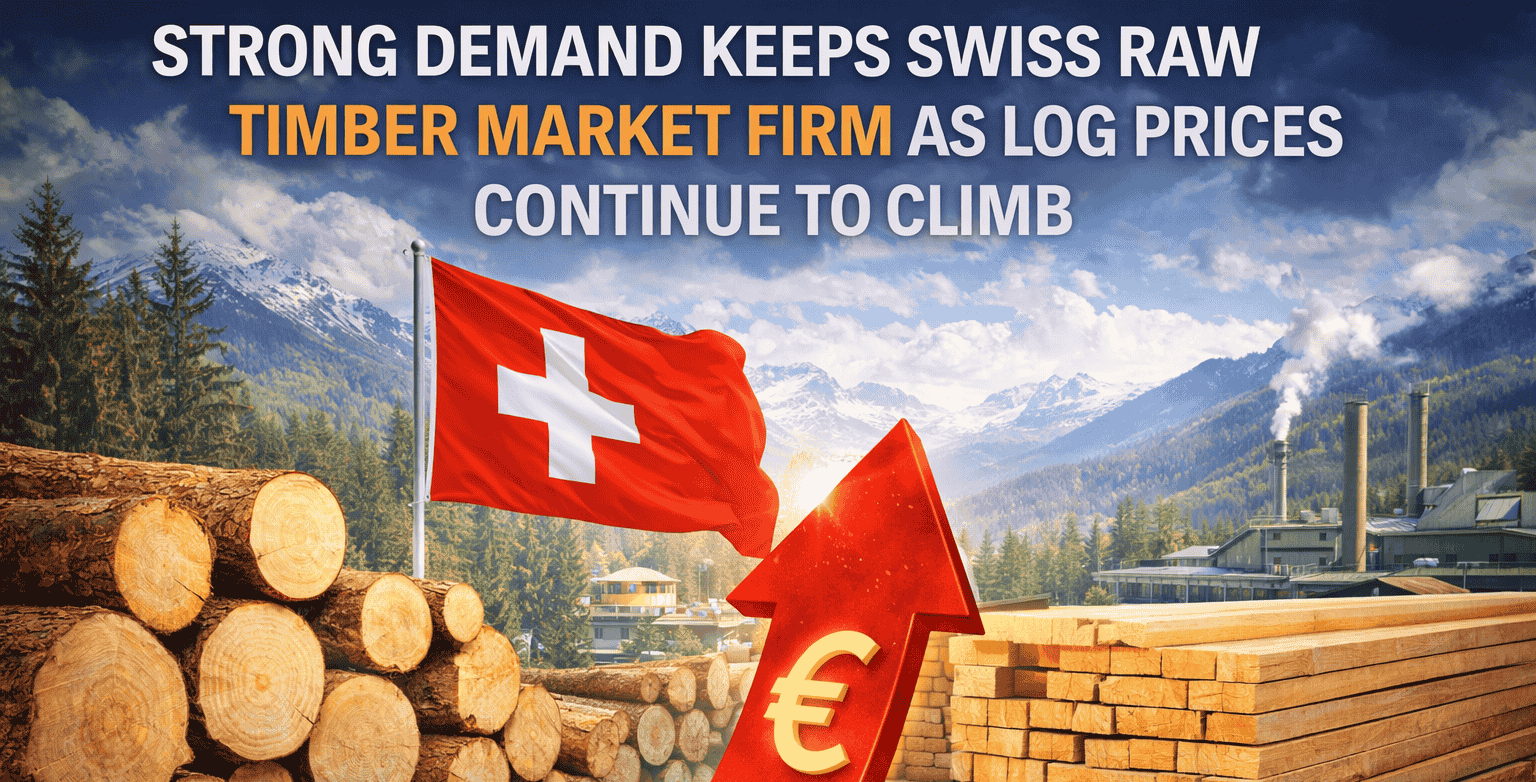
Swiss raw timber demand remains strong, with log prices continuing to move upward as sawmills report solid order books and stable to rising interest in domestic material. The latest discussion at the newly restructured Timber Market Commission (HMK) pointed to a generally favorable market environment, supported by healthy construction activity and high demand for Swiss timber.
The commission, now made up equally of timber suppliers and buyers, held its first meeting in its new composition at the end of January. Going forward, it plans to meet at least twice a year to review market developments.
Sawmills report solid market conditions
According to the HMK, the overall timber market situation is positive. Strong demand for Swiss raw timber is expected to support higher volumes, based on surveys among market participants and timber price statistics. The construction sector’s order situation is broadly viewed as good to very good, with timber construction in particular continuing to show strong and stable capacity utilization. Companies in the timber industry also expect utilization levels to remain steady in the coming months.
Within the sawmilling sector, however, views are not entirely uniform. Large sawmills are describing their order situation as good to very good, while smaller mills assess it as moderate to good. Even so, overall demand for Swiss sawn timber is seen as stable to increasing, while sawn timber inventories are considered adequate to rather low.
Energy wood demand adds further pressure
Demand for Swiss raw timber is also being influenced by a strong energy wood market. Softwood demand, especially for spruce and fir, remains high and is currently exceeding available supply. Around 44% of sawmills are reported to have low roundwood inventories, and the HMK expects this situation to remain largely unchanged in the near term.
Conditions are different in the industrial wood segment. Here, the HMK says demand and prices are stable to declining. The gap between industrial wood prices and energy wood prices has narrowed to the point where some timber that might otherwise go to industrial uses is instead being directed toward energy wood. Seasonal demand is keeping the energy wood market firm, and prices in that segment have risen accordingly.
Demand for coniferous logs is described as stable to rising. Larch, in particular, is seeing strong demand, which has contributed to higher prices.
Hardwood demand remains selective
Hardwood logs continue to play a smaller role in the market. Demand is described as weak to slightly declining overall, with ash and good-quality oak standing out as the main exceptions where buyer interest remains solid.
Focus shifts to price trends
For forest owners and farmers, price developments remain especially important. The HMK noted that substantial regional differences continue to exist across Switzerland. Rather than publishing target prices at its latest meeting, the commission focused on market direction and price trends.
According to the HMK, leading softwood assortments have been on an upward trend since July 2025, with long timber showing the clearest gains. Beech logs, by contrast, are experiencing weak to slightly declining demand and pricing.
The new HMK is backed by Waldschweiz and Holzindustrie Schweiz (HIS). Under the revised legal framework, it is now possible to publish guide prices for Swiss raw timber.
Source: schweizerbauer.ch