

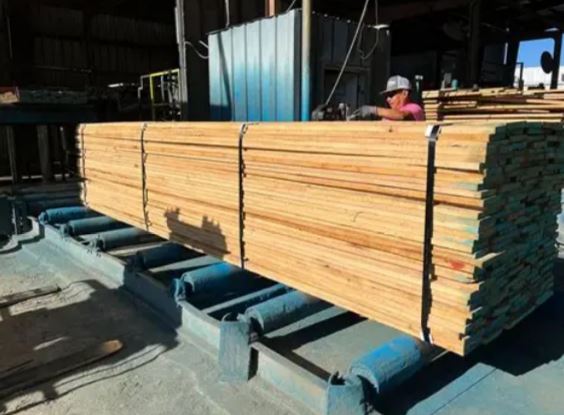
North American hardwood logs, hardwood lumber and a broad range of wood products have been included in the U.S.-China “30-for-30” framework for potentially more favorable tariff treatment, opening the door to improved market access for American forest-product exporters. The measure, however, does not mean that tariffs have already been reduced.
The United States and China have moved another step forward in their effort to rebalance bilateral trade, placing a wide range of American forest products on a list of goods that may qualify for reduced tariff treatment.
The framework was developed through the newly established U.S.-China Board of Trade, a government-to-government mechanism created during U.S. President Donald Trump’s May 2026 visit to Beijing to manage trade in non-sensitive products.
Following Chinese President Xi Jinping’s September 23-25 state visit to the United States, the two governments announced recommendations covering approximately $30 billion worth of goods in each direction.
U.S. Trade Representative Jamieson Greer said the American products under consideration represent roughly 30% of current U.S. exports to China.
China’s Ministry of Foreign Affairs separately confirmed that the two countries had reached an arrangement concerning $30 billion in reciprocal tariff reductions as part of the economic and diplomatic understandings reached during the state visit.
Hardwood Logs and Lumber Both Included
For the U.S. forest-products sector, one of the most important details is that the official Chinese import list does not stop at logs.
The list specifically includes North American hardwood logs under Chinese tariff code 44039960 and North American hardwood lumber under code 44079930.
Several major hardwood species also appear individually within the lumber categories, including oak, beech, maple, cherry, ash, birch and poplar.
Softwood products are represented extensively as well. The list includes pine, fir, spruce, Douglas fir and other softwood logs and sawn lumber.
The scope extends considerably further down the wood-products value chain.
Among the listed categories are:
- veneers,
- flooring strips,
- particleboard,
- oriented strand board, OSB,
- MDF and other fibreboard products,
- plywood and laminated wood,
- wooden doors and frames,
- assembled wooden flooring,
- other joinery and construction wood products.
This breadth is significant because the framework could potentially affect not only raw-material exports but also processed and higher-value wood products.
Tariff Relief Has Not Yet Automatically Taken Effect
The most important qualification is that inclusion on the list does not itself constitute an immediate tariff reduction.
According to the White House documentation, the United States and China will consider the listed products with a view toward providing reduced tariff treatment on a reciprocal basis and in accordance with their respective domestic laws and administrative processes.
The wording makes the current step a recommendation and implementation framework, rather than a completed across-the-board tariff cut.
The Board of Trade’s working procedures similarly state that officials from both countries are tasked with developing proposals covering selected goods before those proposals move through the relevant domestic processes.
For wood exporters, the announcement therefore represents potentially improved future access to China rather than a new tariff rate that can already be assumed in commercial transactions.
U.S. Lawmakers Had Pushed for Lumber, Not Only Logs
The inclusion of hardwood lumber is particularly notable because American lawmakers had explicitly pressed the U.S. administration to ensure that processed lumber was not left behind.
In July, a bipartisan and bicameral group led by U.S. Senators Shelley Moore Capito and Jeanne Shaheen, together with Representatives GT Thompson and Marie Gluesenkamp Perez, urged USTR to include American hardwood lumber in the U.S.-China trade framework.
Their central argument was that increasing exports of unprocessed logs without restoring market access for American lumber could shift more value-added processing overseas.
The lawmakers argued that U.S. sawmills, loggers and rural manufacturing communities would benefit more if Chinese demand supported American-processed hardwood lumber rather than predominantly raw logs.
They also pointed to the severe contraction experienced by the U.S. hardwood industry following years of trade disruption, estimating billions of dollars in lost sales and reporting a substantial decline in domestic hardwood lumber production since 2018.
The final product list is therefore important from the industry’s perspective because both North American hardwood logs and North American hardwood lumber appear within the tariff-relief framework.
China Remains a Crucial but Changed Hardwood Market
The potential reopening of more favorable access comes at a time when the structure of China’s hardwood trade has changed considerably.
According to the U.S. Department of Agriculture’s Foreign Agricultural Service, the United States was China’s leading hardwood lumber supplier from 2014 through 2018, accounting for roughly 30% of the market during that period.
Thailand moved into first place in 2019 and has since strengthened its position.
USDA data show that China imported approximately 9.5 million m³ of hardwood lumber in 2025, down about 5% from the previous year. By physical volume, Thailand accounted for approximately 44% of China’s hardwood lumber imports, while the United States represented around 9%.
The picture looks different when measured by value. U.S. hardwoods tend to occupy higher-value segments of the market, and USDA’s 2026 Hardwood Market Update places the U.S. share of China’s hardwood lumber import value at around 19% in 2025.
Key U.S. species sold into China include black walnut, red oak, white oak, cherry and maple, with applications ranging from furniture and flooring to cabinetry, wall panels and other interior products.
Vietnam’s Rise Adds Another Dimension
China is also no longer the only Asian market shaping the direction of the American hardwood industry.
U.S. hardwood log exports to Vietnam have expanded rapidly in 2026, while Vietnamese processing capacity has become increasingly important to regional wood-product supply chains.
Industry data indicate that Vietnam has emerged as the leading destination for American hardwood logs during parts of 2026, highlighting a broader shift in where raw American hardwood is being processed before entering furniture, flooring and other downstream manufacturing.
This development is one reason U.S. hardwood manufacturers have increasingly focused on the distinction between exporting logs and exporting processed lumber.
If more logs are shipped overseas and converted into lumber abroad, American sawmills can find themselves competing internationally with products manufactured from the same U.S.-grown raw material.
A Potential Opening for the Wider Wood Industry
Although hardwood lumber has attracted much of the attention, the official product list shows that the proposed tariff framework could have implications across a much wider part of the forest-products industry.
The inclusion of particleboard, OSB, MDF, plywood, flooring products, doors and other processed wood categories means the arrangement goes beyond traditional log and lumber trade.
If tariff reductions are eventually implemented, the framework could change the competitiveness of American wood products in China at several stages of the value chain.
For manufacturers, however, the decisive details will be the final tariff rates, implementation dates, product-specific conditions and administrative procedures adopted by the two governments.
Until those steps are completed, the September agreement should be viewed as an important opening for improved trade conditions, but not yet as a completed removal or reduction of existing tariffs.
What is already clear is that wood products have secured a meaningful place in the new U.S.-China trade dialogue. For the American hardwood industry in particular, the inclusion of both raw logs and value-added lumber gives the sector a broader opportunity to rebuild its position in one of the world’s most important wood-consuming markets.