

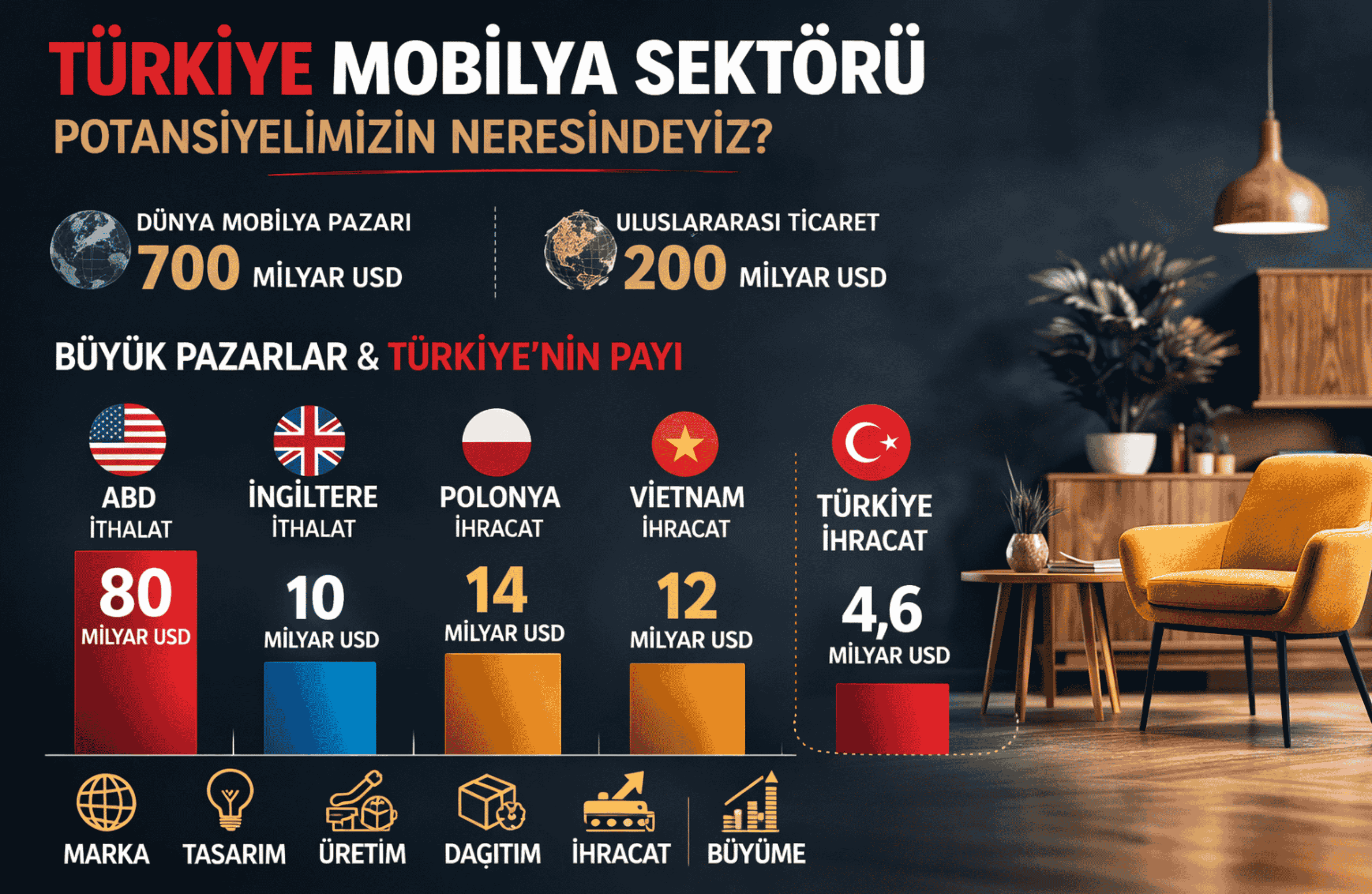
Türkiye’s furniture industry has made strong progress in recent years and is also drawing attention with its export performance. Today, the sector’s exports stand at roughly USD 4.5–4.6 billion. While this points to a meaningful achievement, Türkiye’s current position needs to be evaluated within a broader frame when global market sizes are taken into account.
The global market at a glance
The global furniture market exceeds USD 700 billion in size, while international furniture trade is around USD 200 billion. These figures show that a large part of the global market still consists of local production and local consumption. However, the import volumes of certain countries reveal opportunity areas with much higher potential for exporters.
Major import markets and Türkiye’s share
In this context, the United States and the United Kingdom stand out. The US imports roughly USD 80 billion worth of furniture, while the UK imports about USD 9–10 billion. Türkiye’s exports to these two markets appear more limited. Türkiye’s exports to the US are approximately USD 234 million, while exports to the UK are around USD 161 million. This picture clearly shows that, especially in the US market, Türkiye’s share remains below 1%, highlighting the scale of the growth opportunity.
Leading exporters on a global scale
A similar picture emerges when compared with the leading exporting countries worldwide. Poland stands out as a strong player with roughly EUR 13–14 billion in furniture exports, while Vietnam has reached around USD 12 billion. Türkiye’s export performance of about USD 4.5 billion trails these countries, yet considering Türkiye’s production capacity and infrastructure, it becomes clear that this gap is not only a matter of market share, it is also closely linked to strategic factors such as scale, branding, and distribution models. The comparison becomes even more striking when we consider that Poland’s population is around 38 million, while Türkiye’s population is around 85 million.
Türkiye’s strengths
Türkiye has significant advantages that can help move the sector into a higher league. Geographic proximity to Europe provides a natural competitive space in terms of logistics speed and costs. In addition, Türkiye’s position as one of the world’s largest MDF and particleboard production bases after China creates a strong raw material and semi-finished goods foundation. A developed supplier industry and procurement ecosystem, flexible production capability, and design potential are also among the factors that support stronger positioning in international markets. This infrastructure indicates that Türkiye has the capacity to become not only a producer, but also a powerful furniture manufacturing ecosystem for Europe and neighboring regions.
Key levers for the next leap
For the sector’s next phase of growth, certain priorities become more decisive. Reaching a higher share in global markets requires more than expanding production capacity alone. Building a global brand, meaning not only producing but selling branded products, stands out as one of the core steps that will increase value added.
At the same time, establishing strong and lasting distribution channels, especially building distribution networks in the US and Europe, is critical for creating continuity and scale in the market. On the design and product development side, a design-driven growth approach offers a powerful lever for differentiation and moving away from pure price competition.
Economies of scale also appear as a defining factor in global success stories across the sector. While this factor is frequently emphasized in the high export performance of Poland and Vietnam, a scale-oriented approach is becoming a strategic priority for Türkiye’s growth targets as well. In addition, working with local partners and building a strong on-the-ground structure with professional sales teams is seen as critical for success in international markets. Especially if the US is targeted, it is often noted that working with local sales and marketing managers who know that market well and have spent years in the sector can make a major difference.
In this context, Türkiye’s Turquality program is also viewed as an important opportunity for branding and overseas growth goals. It is stated that the program provides companies with consultancy and strategic support. Considering the sector’s manufacturing strength, panel infrastructure, and entrepreneurial culture, Türkiye’s potential to become a stronger player in the global market appears high. Using this potential more effectively seems directly linked to actions in branding, distribution, design, scale, and local market structuring.
Sources
- Naci Güngör – Boyut Plastik
- https://www.trademap.org