

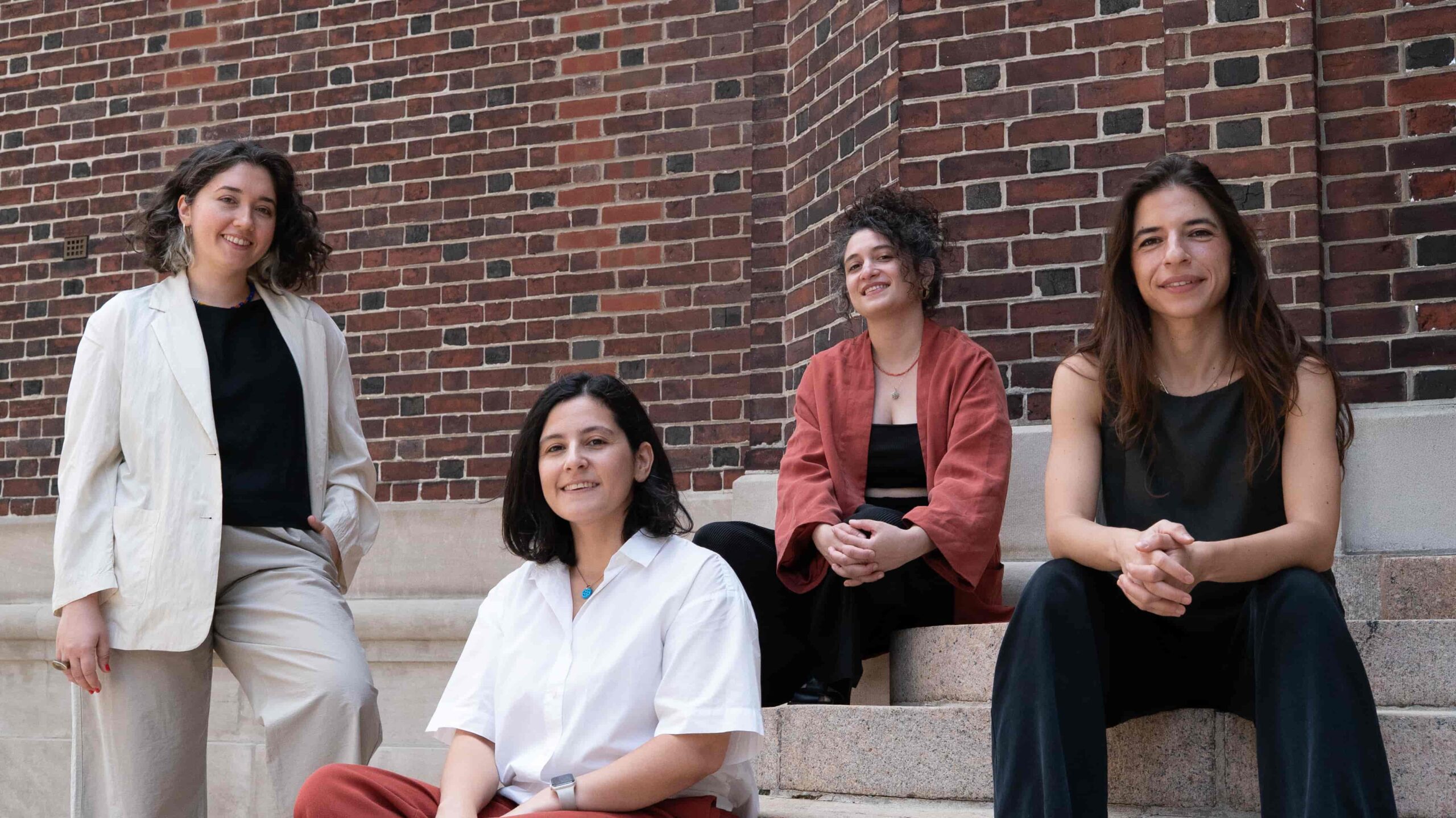
The Türkiye Pavilion at the Venice Architecture Biennale, coordinated by the Istanbul Foundation for Culture and Arts, İKSV, will present the project “Spolia Futures”, curated by ba-be commons, next year.
The two-stage open call organized to select the project for the Türkiye Pavilion at the 20th International Architecture Exhibition of La Biennale di Venezia has concluded. After evaluating a total of 43 applications submitted to the open call, the Selection Committee chose “Spolia Futures”, developed by the ba-be commons team comprising Başak Eren, Asya Ece Uzmay, Beril Sarısakal Erkent and Ece Yetim. The project will be exhibited at the Türkiye Pavilion during the Venice Architecture Biennale, which will take place from May 8 to November 21, 2027.
The Selection Committee, comprising Hülya Ertaş, Bilge Kalfa, Cem Sorguç, Melis Varkal and Prof. Dr. Şebnem Yücel, selected “Spolia Futures” from among three projects invited to the second stage of the open call, each of which stood out with its distinct content and design proposal.
The Selection Committee explained its reasons for choosing the project as follows:
“The ‘Spolia Futures’ exhibition stood out with its strong conceptual framework concerning the tradition of spolia, which also forms part of the historical context of architectural practice, and its potential to bring spolia techniques specific to this geography into the global architectural discourse. The project examines spolia, a construction method that changes and transforms over time and renews its relevance through continuous additions, through the categories of coexistence, archiving, slowing down, repair and speculation about the future. Developed through research and collaborations with artists, the pavilion focuses on how spolia may shape the architecture of the future.”
“Spolia Futures” approaches spolia not merely as a practice of reuse belonging to the past, but as a critical method that establishes new relationships among materials, ecologies, memory and social relations and enables architecture to be reconsidered in the face of planetary crises. By confronting the historical burden arising from the imperial past of spolia and reversing its established meanings, the project aims to open a discussion on whether it can be reimagined as an egalitarian mode of making.
Drawing on Türkiye’s cultures of production and repair, the exhibition will propose a circular, local and commons-based understanding of architecture as an alternative to production models that exploit natural resources. This approach will also take physical form in the spatial design of the exhibition, inviting visitors to explore and transform the method of spolia and question the architectural legacy that will be left to the future.
The exhibition at the Türkiye Pavilion of the Venice Architecture Biennale, coordinated by the Istanbul Foundation for Culture and Arts, is being realized with the contribution of the Ministry of Culture and Tourism of the Republic of Türkiye, under the auspices of the Ministry of Foreign Affairs of the Republic of Türkiye and with the co-sponsorship of Schüco Türkiye and VitrA.
CURATORIAL TEAM
ba-be commons is a research collective formed by Başak Eren, Asya Ece Uzmay, Beril Sarısakal Erkent and Ece Yetim, whose collaboration began at the Faculty of Architecture of Istanbul Technical University. Başak Eren graduated from the Department of Architecture at Istanbul Technical University in 2015, while the other members of the team graduated in 2016. They later pursued academic studies in architectural history, theory, design and architectural representation at different universities in the United States and reunited around their shared areas of interest.
Today, Başak Eren continues her doctoral studies at the University of Pennsylvania Weitzman School of Design, Asya Ece Uzmay at Cornell University College of Architecture, Art and Planning and Beril Sarısakal Erkent at Columbia University Graduate School of Architecture, Planning and Preservation. Ece Yetim teaches at the Wentworth Institute of Technology and the Rhode Island School of Design. Their work focuses on architectural history and theory, architectural representation practices and design research. Developed for the Türkiye Pavilion at the 2027 Venice Architecture Biennale, “Spolia Futures” brings together the research they have conducted over many years in different countries and institutions in a shared architectural proposal.
Başak Eren
An architect, educator and researcher, Başak Eren is a doctoral candidate in the Department of Architecture at the University of Pennsylvania Weitzman School of Design. Her research examines architectural production displaced during the formation of nation-states in the 20th century, the circulation of architecture and architectural knowledge and the ways in which these forms of production are represented in archives through an intersectional approach.
Her research has been supported by various institutions, including the Canadian Centre for Architecture, CCA, Penn Global and the University of Pennsylvania Graduate and Professional Student Assembly, GAPSA. Eren completed her undergraduate degree in architecture and master’s degree in architectural design at Istanbul Technical University. Before beginning her doctoral studies, she worked as a research assistant at MEF University. Having produced award-winning projects and completed works at various scales, from urban interventions to spatial installations, Eren continues to establish connections between her academic research and design practice.
Asya Ece Uzmay
Asya Ece Uzmay is an architect, educator and researcher. Her work examines the relationship between architecture and the management of natural resources in late Ottoman and post-Ottoman geographies through the lenses of modernity, imperialism, labor, infrastructure and agriculture.
Her research has been supported by various institutions, including the Canadian Centre for Architecture, CCA, the Einaudi Center for International Studies and the Society of Architectural Historians. Her writings have been published in edited volumes and journals in both Turkish and English. She has contributed to various exhibitions at SALT, held teaching positions at Cornell University, Barnard College and Kadir Has University and worked as a researcher at the Center for Istanbul Studies.
Uzmay is a doctoral candidate at Cornell University College of Architecture, Art and Planning. She holds a master’s degree in architecture and urban studies from Kadir Has University and a bachelor’s degree in architecture from Istanbul Technical University.
Beril Sarısakal Erkent
Beril Sarısakal Erkent is an architect, educator and researcher. A doctoral candidate at Columbia University Graduate School of Architecture, Planning and Preservation, GSAPP, her research focuses on design and architectural epistemologies in the late Ottoman and early Republican periods, technocracy in architectural history and the body politics of empires.
Her work has been supported by Yale University, the Decorative Arts Trust, the College Art Association and Columbia GSAPP. Sarısakal Erkent received her bachelor’s degree in architecture and master’s degree in architectural history from Istanbul Technical University. Before beginning her doctoral studies, she worked as a project assistant at cultural institutions including SALT Galata and as a research assistant at MEF University. Her research has been published in various academic journals, including the International Journal of Islamic Architecture, IJIA, and The Muslim World.
Ece Yetim
An architect, designer and academic, Ece Yetim is a visiting faculty member at the School of Architecture and Design of the Wentworth Institute of Technology and a part-time faculty member at the Rhode Island School of Design, RISD.
Her work approaches architectural representation as a political instrument and focuses on public space, collective agency and the forms of solidarity that architecture can produce. She is one of the co-founders of KOMM.unity, a design collective that develops transformative furniture aimed at strengthening community ties.
She previously worked on a variety of projects ranging from exhibition design to museum projects at Höweler + Yoon Architecture, Studio Daniel Libeskind and Atelier Bow-Wow. Yetim holds a master’s degree in architecture from Princeton University and a bachelor’s degree in architecture from Istanbul Technical University. Her published works include Shadowing the Silence: A Spatial Rewriting of Myths, co-authored with Aslıhan Şenel in 2023, her editorial contribution to the book Lina Bo Bardi: Material Ideologies in 2022 and Different Scales of Solidarity, published in MONU in 2021.
20TH INTERNATIONAL ARCHITECTURE EXHIBITION OF LA BIENNALE DI VENEZIA
Pietrangelo Buttafuoco, President of La Biennale di Venezia, and Wang Shu and Lu Wenyu, curators of the 20th International Architecture Exhibition, previously announced the title and theme of the exhibition as “Do Architecture — For the Possibility of Coexistence Facing a Real Reality.”
The Biennale will take place at the Giardini, the Arsenale and various venues across Venice from May 8 to November 21, 2027, with preview days on May 6 and 7.
ISTANBUL FOUNDATION FOR CULTURE AND ARTS AND THE TÜRKİYE PAVILION
Through the initiative of the Istanbul Foundation for Culture and Arts, which has coordinated the Türkiye Pavilion since 2007, and with contributions from 21 supporters, Türkiye secured a long-term venue at La Biennale di Venezia beginning in 2014. The space, allocated between 2014 and 2034 in the Arsenale, one of the Biennale’s two main exhibition areas, enabled the Türkiye Pavilion to participate in the International Architecture Exhibition of La Biennale di Venezia for the first time in 2014.
At the Türkiye Pavilion of the 14th International Architecture Exhibition in 2014, the project “Places of Memory” was presented. It was prepared by curator Murat Tabanlıoğlu and project coordinator Pelin Derviş together with exhibition team members Ali Taptık, Alper Derinboğaz, Candaş Şişman, Metehan Özcan and Serkan Taycan.
At the Türkiye Pavilion of the 15th International Architecture Exhibition in 2016, the project “Darzanà”, curated by Feride Çiçekoğlu, Mehmet V. Kütükçüoğlu and Ertuğ Uçar, was exhibited.
The 2018 Türkiye Pavilion presented “Vardiya”, curated by Kerem Piker. With Cansu Cürgen, Yelta Köm, Nizam Onur Sönmez, Yağız Söylev and Erdem Tüzün serving as assistant curators, “Vardiya” offered a broadly participatory space for encounters, gatherings and architectural production.
In 2021, the Türkiye Pavilion hosted Neyran Turan’s project “Architecture as Measure,” which explored how architecture could offer new perspectives in response to the climate crisis. E. Ece Emanetoğlu, Melis Uğurlu, Betsy Clifton and Samet Mor served as assistant curators of the project.
At the Türkiye Pavilion of the 18th International Architecture Exhibition in 2023, the project “Ghost Stories: The Carrier Bag Theory of Architecture,” curated by Sevince Bayrak and Oral Göktaş, questioned established images and approaches concerning buildings. Rather than focusing on spectacular and successful examples, it proposed examining the stories of abandoned buildings.
In 2025, the project “Grounded,” curated by Ceren Erdem and Bilge Kalfa, emphasized the qualities of soil as a source of life, memory and knowledge. Establishing a connection between the past and the future, the project brought together sensory experiences, scientific documentation, architecture and works of art.